Saturday, 10 August 2019

Cats can be wonderful companions for older adults


(Good Free Photos)
Dogs may be man’s best friend, but cats reign as the most popular pet in Canada.
“I always considered myself a dog person,” says Audrey Green, 61. “However, I work full-time and there was no way I could take care of one. Then I saw Ruby and I instantly fell in love.”
Green adopted Ruby as a kitten from a cat rescue organization last year. “From the moment I saw her, it was love at first sight,” she says. “I never had a cat of my own before, but now I can’t imagine life without her.”
When Green walks in the door, Ruby is there to greet her and make her laugh. “She has her own mat in the kitchen where I keep her food bowl,” she says. “One day, we were both eating and suddenly she dragged the entire mat closer to my chair so we could eat side by side! People don’t realize just how wonderful cats are or what good company they can be.”
Green has trained Ruby to give kisses, especially when she wants to eat. “She taps me on the face. It’s so sweet,” she says. “I have three grown children and two grandchildren, but Ruby is my fur-baby.”
Audrey Green and her “fur-baby” Ruby.
Jerry Solomon, 72, and his wife Gloria have been providing a home for elderly and infirm cats since they both retired. “Cats are such beautiful creatures,” he says. “We adopt the ones that have been living out their years in a cage.”
There’s no shortage of cats who need a home, something the couple realized they could easily provide. “They fit in well with our lifestyle,” he says. “We don’t have to walk them, and if we’re gone for a few hours, we know they’re fine at home. When we return, there’s all these lovely little faces waiting for us.”
The couple now has four cats, ranging from ages six to 16. “Our youngest, Polo, came from our vet’s office,” he says. “His owners wanted to put him down because he had a broken leg, but he was only four. So, we took over and now he’s as good as new.”
Adopting an older animal may involve more health issues, but this isn’t necessarily so, he adds. “We adopted our first senior at age 11 and she lived until 19,” he says. “Senior pets are special. They’re grateful for a warm bed, regular food and someone to care about them. It’s not so different than with people.”
Despite their popularity, cats – both stray pets and feral felines – also make up the largest population of homeless pets in Canada. “Feral cats have reverted to a wild state and can’t get used to human contact,” says animal advocate Lydia Carter.
To address the problem, changes need to be made, starting with spay/neuter laws and prosecuting people who abandon animals – a crime in Canada that is rarely enforced. “Another issue is that many landlords or seniors residences in Quebec don’t allow animals, which can force people to give up their pet,” adds Carter.
Then there’s the mentality that animals are disposable. “Sometimes students adopt a cat to keep them company,” she says. “Then when they go back home, they discard them like they’re a piece of furniture.”
Polo found a loving home after he broke his leg.
In the community of Côte-St-Luc, the CSL Cats Committee addresses the problem of homeless cats with their Trap, Neuter, Return, Maintain (TNRM) program. “We call the feral population community cats now,” says chair Diane Liebling. “We re-release them with assurance from the resident that they will feed, water and shelter the cat for the rest of its natural life. Some residents have been feeding the same cats for years.”
The committee holds a Food for Felines fundraiser every November to February to collect food and/or funds. They also provide Styrofoam shelters to help the homeless cats survive Quebec winters. “There’s no question that every cat deserves a home,” says Leibling. “But if they can’t have one, they still deserve to be treated with love, care and dignity.”
If you’d like to make a difference in a cat’s life, visit your local shelter.
The CSL Cat Committee can be reached at 514-485-6800 ext. CATS (2287).

Tuesday, 16 July 2019

The Algonquin Hotel cat: A fabulous story for anyone who loves felines

I absolutely love the historic Algonquin Hotel. It is always our first choice when visiting New York City. Located on 44th Street, near 6th Avenue, walk out the front door and you are a block and a half away from Times Square. 
Hamlet strikes a pose. (Lisa Raymond Photo)

The Algonquin first opened its doors in 1902. Today, it is part of the Marriott chain’s Autograph Collection, an evolving ensemble of strikingly independent hotels. Each destination has been selected for its quality, bold originality, rich character, and uncommon details. The result is an array of properties that is nothing less than unique. The Algonquin Hotel was the first New York City property to become a part of the collection. 
   
For well more than 100 years, the Algonquin has been greeting and lodging the country's most prominent writers and literary personalities, as well as the leading figures of the American stage. The hotel is best known, perhaps, for the members of the Round Table, a group of luminaries who had in common both the ability to fire blazing witticisms and to withstand being on the receiving end of them. 

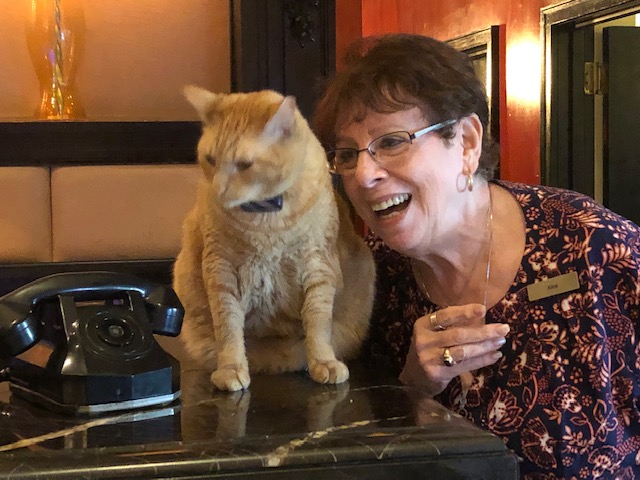
Alice De Almeida shows her passion for Hamlet.
There are many reasons why The Algonquin is our family's chosen hotel in New York. As cat lovers it pains us to be separated from Cleopatra, our  magnificent tortoiseshell cat who regrettably cannot come on holiday with us. The Algonquin Cat has been a fixture at this iconic hotel for almost a century now so we were very excited to see Hamlet VIII, the three year-old orange cat who calls this hotel his home. According to hotel executive assistant Alice De Almeida, he was originally a feral cat found in Long Island and brought to the Bide-a-wee shelter (the oldest shelter in the Big Apple), where the Algonquin then adopted him as their own. He came to the hotel in July 2017 after their former cat, Matilda III, retired. “He is so friendly and lovable that people who never liked cats love him.” Alice says proudly. “He has great purrsonality!”

Hamlet lets me pet him.
Joanna Szepietowska is the recently appointed rooms operations manager at the hotel. She admitted to me that she was not much of a cat lover before coming to work here, but Hamlet has changed that in a big way. She is looking into adopting her own cat now.

Hamlet has his own Twitter and Instagram accounts, as well as an email account.  “I take care of all his needs, front and back, vet visits and more,” says Alice, a wonderful lady who gets into the office each weekday at 6:30 am and immediately gives Hamlet a big kiss.

Alice  has three cats of her own at home and feeds several ferals in her area. She came to work at this hotel in 2005 and quickly became the natural guardian of the resident cats. “I have become a real Jewish mother to our cats,” she laughs.

Based on the timeline of a book written by the hotel’s first general manager, the hotel is now proud to say that the lineage of The Algonquin Cat dates back to the early 1920s. Two days after this first cat, Billy, passed, another stray cat wandered into the hotel and The Algonquin welcomed Rusty. The famous classical actor, John Barrymore, best known for playing Hamlet on stage, was a resident at the time in the early 1930s, and Rusty was renamed Hamlet in his honor. The lineage thus far now includes eight Hamlets and three Matildas. Each cat that has reigned at The Algonquin has been a rescue. 

The hotel’s executive chef cooks Hamlet special meals on holidays. He receives fan mail and gifts constantly from around the world. He has recently been the subject of a painting that hangs above the Front Desk, by New York artist Marcus Pierno. Hamlet can often be found at the front desk, in one of his two tree houses or prancing through the lobby. He has been trained to never go outside and is wonderful with everyone who wants to pet him.
This fellow  was in last year's Cat Fashion Show.


Every August The Algonquin hosts an annual Cat Fashion Show to raise money for the Mayor's Alliance for NYC's Animals. The event  brings together the city’s most fashionable felines to strut their stuff in one-of-a-kind outfits that coincide with  different themes – the 2019 edition being “It’s a Small World.”   Hamlet VIII is naturally the star.

The spectacle begins with cocktails, hors d’oeuvres and desserts; a silent auction featuring a variety of kitty-centric items; an on-site mobile adoption unit in front of the hotel that day and of course NYC cats hitting the catwalk in opulent threads designed by legendary pet fashion designer Ada Nieves. Human guests are encouraged to wear their most eccentric, feline-inspired outfit and share photos from the un-fur-gettable night on social media using the hashtag #AlgonquinCat.

A total of 100 percent of proceeds benefits the Mayor's Alliance for NYC's Animals, a non-profit charity that works with more than 150 partner rescue groups and shelters to offer important programs and services that save the lives of NYC's homeless animals. A raffle raises additional funds throughout the evening, with prizes including a variety of pet products curated by the event’s co-chair, pet lifestyle expert and author Sandy Robins. 

Hamlet can be found on Facebook, Twitter and Instagram.  He can also be reached via email: hamletalgonquincat@algonquinhotel.com. 

A home away from home

After World War I, Vanity Fair writers and Algonquin regulars Dorothy Parker, Robert Benchley and Robert E. Sherwood began lunching at the Algonquin. Though society columns referred to them as the Algonquin Round Table, they called themselves the Vicious Circle. "By force of character," observed drama critic Brooks Atkinson, "they changed the nature of American comedy and established the tastes of a new period in the arts and theatre."


This year marks the centennial of the Round Table and as a result special programming took place all summer long. We were there to take in some of the festivities

Each of the 181 rooms and 25 suites features a comfortable well-lit work desk, as well as complimentary Wi-Fi. We stayed in a very comfortable one bedroom Heywood Broun Suite, named for the noted American journalist, sportswriter and newspaper columnist in New York City who founded the American Newspaper Guild.

The layout was ideally suited for us. There is a nice sized entrance, with the master bedroom to the left featuring a nice-sized bathroom. The spacious living room has a pullout couch, a large desk which was perfect for me to write my stories and good drawer and cupboard space. You can get a fridge and a microwave, depending upon availability and on request.

When you enter the hotel, you come face to face with the casual Lobby Lounge, along with The Round Table Restaurant. Just to the left is the hotel’s trendy and aptly named Blue Bar. 

The Algonquin Hotel is located at 59 W 44th Street, New York, New York 10036. www.algonquinhotel.com. Info: 212-840-6800


Save the Date for our 2019 Concert - October 24


The Côte Saint-Luc Cats Committee (CSLCC) will hold its annual benefit concert on Thursday, October 24 (7:30 p.m.) at the Syd Wise Auditorium (5785 Parkhaven) of the Wagar Adult Education Centre.  Featured performers  for Broadway’s Greatest Hits will be the Musicians of the World Symphony Orchestra (http://www.musiciansoftheworld.ca), conducted by Joseph Milo. Some members of his orchestra  will  also present solo performances by soprano Olivia Charette-Hacinsky, baritone Burney Lieberman and saxophonist Gideon Vigderhaus.

Funds raised will go towards the CSLCC’s Trap, Neuter, Release and Adopt Program. There are many feral cats in the community. The CSLCC’s team of volunteers sets out to trap as many as possible, have them sterilized and then adopted or returned to the spot where they were originally found.  In the latter case, efforts are made to assist the feeders in the community. The committee has also rescued a number of  kittens and found homes for them.  

Councillor Mike Cohen, responsible for Animal Protection in the city, notes that the concert will be an opportunity for people who love animals to enjoy an evening of fine music while contributing to a good cause.   He also wishes to announce that Expedia Cruise Ship Centres, with franchisee Sean Flynn; Gestion Elm, Rozenblat Realty Group and Parkhaven Towers; and D’Arcy McGee Liberal MNA David Birnbaum,  will be the evening’s official sponsors.

The Musicians of the World Symphony Orchestra (MWSO) was founded in 2006 by conductor  Milo and his wife Lucy Ravinsky. This one of a kind orchestra is composed of 55 musicians: about 80 percent of its members are from 15 countries around the world, while the remaining 20 percent are natives of Montreal who successfully facilitated the integration of the newcomers. They have been rehearsing at Côte Saint-Luc City Hall for many years and as part of the arrangement, they agree to perform a benefit concert once a year for the CSL Cats Committee.

Tickets are only $15 each (tax included). A limited number of VIP reserved seats are available for $25.  Special prices can be arranged for groups. They can be purchased at the CSL Public Library (5851 Cavendish Boulevard) and  the Côte St. Luc Hospital for Animals (7930 Baily Road) on Baily Road. Tickets can be purchased at the library by credit and debit card or cash and cash only at the Animal Hospital.

Councillor  Cohen and event Co-Chair Councillor Mitch Kujavsky note that information will be available that night for people interested in possibly joining the committee or adopting a cat.  The committee will hold a bake sale before the concert and at intermission, with proceeds going to the outdoor cat feeding program. Diane Liebling chairs the CSL Cats Committee.   

There will also be a raffle. The grand prize will be a three night stay at the Embassy Suites Hotel in Old Montreal with a fully cooked morning breakfast each day, evening receptions and dinner for two at the restaurant. It is valued at $1,200.   

The  event is being organized by the CSL Public Library.

Here is a link to last year's concert: 
https://www.youtube.com/watch?v=n5Hbnlkxtw4

For more information call 514-485-6806, ext. 2200 or log on to www.cotesaintluc.org/catscommittee.


Sunday, 14 October 2018

Recap of 2018 CSL Cats Committee Benefit Concert

On October 9 at the Wagar Auditorium, the CSL Cats Committee held its annual benefit concert.

Click here for  a complete recap.

If you scroll to the very bottom you will see links to TV and Radio coverage.


Conductor Joseph Milo


Saturday, 29 September 2018

Montreal Gazette Story on Cats Committee and Quebec Election

Quebec election: A councillor calls for new ministry of animal welfare

'There are so many municipalities with different laws on pets, but the provincial government needs to take leadership,' says Mike Cohen.
Côte-St-Luc councillor Mike Cohen and Nancy Reich with twins LuLu and MiMi, whom she adopted from a litter born to a feral cat. DAVE SIDAWAY / DAVE SIDAWAY / MONTREAL GAZETTE
SHAREADJUSTCOMMENTPRINT
Mike Cohen has a big beef with the major provincial parties: “They are not really addressing the needs of thousands and thousands of constituents.”
Namely, cats and dogs.
Cohen, the Côte-St-Luc city councillor responsible for animal protection, has a soft spot for pets, particularly cats. But he laments that while the provincial parties have made billions of dollars of promises to two-legged constituents in this election campaign, they have talked precious little about animal welfare.
For the last eight years, Cohen has been at the forefront of Côte-St-Luc’s Trap, Neuter, Release and Adopt Program, which has successfully dealt with the plight of nearly 500 feral cats in the community. To raise funds for the program, the Côte-St-Luc Cats Committee, which Cohen founded, will be holding its annual benefit concert, featuring the Musicians of the World Symphony Orchestra, Oct. 9 at the Syd Wise Auditorium.
Cohen estimates that Côte-St-Luc alone is home to many thousands of homeless cats. “And that doesn’t take into consideration all those that die daily.”
“So, do the math and draw conclusions about the number of feral cats as well as homeless dogs throughout the province,” says Cohen, who started the Côte-St-Luc Dog-Owners Committee this year.
“I think it’s insulting that provincial governments over the last many decades have basically thrown these animals under the umbrella of the minister of agriculture. That ministry has sort of been responsible for animal welfare, but has achieved only limited success.”
Cohen’s concern is shared by the Montreal SPCA. In July, the Montreal SPCA mandated Léger Marketing to undertake a poll assessing the importance of animal welfare to Quebec voters. The survey determined that 72 per cent of Quebecers felt it was “very important” or “somewhat important” for candidates to address issues affecting animals during this election campaign.
So in August, the Montreal SPCA sent out a questionnaire to the main political parties to learn more about their positions on several animal welfare issues.
“All the parties to which the Montreal SPCA sent its questionnaire — apart from the Quebec Liberal Party, which refused to participate — seem to recognize the importance of animal welfare issues in the eyes of voters, as all of them state that this is an issue of great importance,” Sophie Gaillard, director of animal advocacy at the Montreal SPCA, notes in her analysis.
“Yet only two parties suggest concrete measures to improve animal protection in Quebec. The Coalition Avenir Québec and the Parti Québécois both responded to only a small number of the questions submitted. Only Québec solidaire and the Green Party of Quebec took the time to answer the questionnaire in its entirety and seem to have given these issues serious thought.”
Québec solidaire wants the Montreal model — requiring pet stores to source animals for sale from shelters — to be expanded throughout the province. As well, it’s against the permanent chaining of dogs and no-pet clauses in residential leases.
Green Party concurs on the latter two issues but would also like to ban the sale of all cats and dogs in pet stores and on the internet, and to impose mandatory sterilization on pets with the exception of small, family-scale breeders.
Cohen isn’t surprised by this seeming lack of interest on the part of three of the major provincial parties and suggests that the situation will only change when pet owners and other concerned citizens speak up and force politicians to address animal welfare issues.
“Animal advocates have been shunted to the side, but the time will come when the situation with homeless cats and dangerous dogs will reach epidemic proportions here and something will have to be done,” Cohen says. “There are so many municipalities with different laws on pets, but the provincial government needs to take leadership and have laws that bring all the municipalities together.”
He concedes his passion for pets hasn’t been a lifelong affair.
“I honestly didn’t like cats 23 years ago, but they came as part of my marriage,” he says. “I’ve since had four cats and they’ve been like humans to me.
“How many other voters out there feel the same way? Yet we have no idea how the provincial party leaders feel about pets — if they even have them. We haven’t heard them bring this up during the campaign. So I’m calling for the next Quebec premier to appoint a minister of animal welfare. Time has come for an animal program with some teeth.”
Maybe claws, too.
AT A GLANCE
The annual Côte-St-Luc Cats Concert, featuring the Musicians of the World Symphony Orchestra, takes place Tuesday, Oct. 9 at 7:30 p.m. at the Syd Wise Auditorium, 5785 Parkhaven Ave. Tickets: $15. Reservations: http://bit.ly/catsconcert.
bbrownstein@postmedia.co


Sunday, 19 August 2018

Tuesday: October 9: CSL Cats Committee Set For 7th Annual Benefit Concert with Musicians of the World

The Côte Saint-Luc Cats Committee (CSLCC) will hold its annual benefit concert on Tuesday, October 9 (7:30 p.m.) at the Syd Wise Auditorium (5785 Parkhaven) of the Wagar Adult Education Centre.  Featured performers will be the Musicians of the World Symphony Orchestra,  conducted by Joseph Milo. Some members of his orchestra  will  also present solo performances. The theme will be Jazz and Symphony.  Gideon Vigderhaus will be the featured soloist on saxophone while Nicole Arrage will be the singing soloist.

Funds raised will go towards the CSLCC’s Trap, Neuter, Release and Adopt Program. There are many feral cats in the community. The CSLCC’s team of volunteers sets out to trap as many as possible, have them sterilized and then adopted or returned to the spot where they were originally found.  In the latter case, efforts are made to assist the feeders in the community. The committee has also rescued a number of  kittens and found homes for them.


Councillor Mike Cohen, responsible for Animal Protection in the city, notes that the concert will be an opportunity for people who love animals to enjoy an evening of fine music while contributing to a good cause.   He also wishes to announce that Expedia Cruise Ship Centres, with franchisee Sean Flynn; Little Bear Pet Supplies on St. Catherine Street in Westmount and D’Arcy McGee Liberal MNA David Birnbaum,  will be the evening’s official sponsors.

The Musicians of the World Symphony Orchestra (MWSO) was founded in 2006 by conductor  Milo and his wife Lucy Ravinsky. This one of a kind orchestra is composed of 55 musicians: about 80 percent of its members are from 15 countries around the world, while the remaining 20 percent are natives of Montreal who successfully facilitated the integration of the newcomers. They have been rehearsing at Côte Saint-Luc City Hall for many years and as part of the arrangement, they agree to perform a benefit concert once a year for the CSL Cats Committee.

Tickets are now $15 (tax included). A limited number of VIP reserved seats are available for $25.  Seats are also available online via Showtix for $15 plus a small service charge.  Please go to
bit.ly/catsconcert

Tickets  are now available at the following locations: the main desk at the Eleanor London Côte Saint-Luc Public Library (5851 Cavendish Boulevard) and the Côte Saint-Luc Hospital for Animals (7930 Baily Road). Tickets can be purchased at the library by credit and debit card or cash and cash only at the Animal Hospital.

Local artist Nelly Leitner has donated this painting to the committee to be auctioned off at the concert.
Councillor  Cohen and event Co-Chair Councillor Mitch Kujavsky note that information will be available that night for people interested in possibly joining the committee or adopting a cat.  The committee will hold a bake sale before the concert and at intermission, with proceeds going to the outdoor cat feeding program. Diane Liebling chairs the CSL Cats Committee.  She said the committee is pleased to have moved the event from summer to the fall. “I think our audience members will be much more comfortable with the summer heat no longer an issue,” she said.

The  event is being organized by the CSL Public Library and coordinated by Danielle Belanger. The  committee wishes to thank Nicholas Katalifos, Michel Leblanc, Hipolito Corral and the staff at the Wagar Adult Education Centre for their cooperation, as well as key event contributors Alvin Fishman, Harold Cammy, Maurizio Giobbi,  Regine Banon, Lisa Milner, Justin Burnham and Library Director Janine West for their assistance.

For more information call 514-485-6806, ext. 2200 or log on to www.cotesaintluc.org/cats.

Wednesday, 24 January 2018

What happened to Montreal's animal shelter?

Delays, cost overruns dog Montreal's animal shelter
In 2011, the city announced it would build a centre to reduce the number of abandoned or stray dogs and cats destroyed. So what happened?
Published on: January 24, 2018 | Last Updated: January 24, 2018 4:30 PM EST
Of the more than 26,000 lost, abandoned or stray dogs and cats that end up in shelters every year in Montreal, an estimated 50 to 60 per cent are put down for want of a home, according to city figures.
That works out to slightly more than 1,000 dogs and cats killed each month.
In Calgary, where the dog population is of similar size, the euthanization rate for dogs is about five per cent.
There is no simple explanation for the glaring discrepancy, but what Calgary has and Montreal lacks is an animal-services centre that has helped position the city among the leaders in animal control in North America.
In 2011, the city of Montreal announced it would build such a centre to drastically reduce the number of animals needlessly destroyed, but that was four mayors ago. The centre was supposed to open in 2016.


Not only has the project been delayed, but the estimated cost has skyrocketed from $23 million to $46 million — roughly $41 million more than what Calgary paid for its bare-bones but vaunted facility in 2000.
The price has surged because the proposed site is a former municipal dump heavily contaminated with hydrocarbons and other toxins. Decontamination costs could amount to as much as the cost of the centre itself.
Last week, the new administration of Mayor Valérie Plante told the Montreal Gazette that if the centre is built, it might not be until 2022. More than $1 million has already been spent on studies and plans.
Meanwhile, construction is underway on a similar animal-services centre in Laval — for $15.3 million. It’s scheduled to open in 2019.
Requests for interviews with Montreal civil servants working on the dossier have been refused. A new call for tenders is in the works, explained city spokesperson Gonzalo Nunez, and those with knowledge of the file “don’t have all the elements needed for answers in hand.”
Last week, during a meeting of the city’s finance committee to study the 2018 municipal budget, the latest estimated price of $46 million came to light, thanks to questions posed by opposition councillor and committee president Richard Deschamps.
“Is there no one at the city who thinks this doesn’t make sense?” said Deschamps, quoted in Le Devoir. “It’s troubling.”
Seven years after the facility was first promised, costs are spiralling and its future remains in doubt, along with the fate of tens of thousands of animals it was designed to save.

It was under the administration of then-mayor Gérald Tremblay that Montreal first proposed to build a Calgary-style centre to better protect its animals.
The decision was spurred by citizen outrage over news reports depicting cruelty at shelters run by Berger Blanc, and statistics showing Montreal has some of the highest animal-abandonment and euthanization rates in North America.
Then and now, most boroughs signed contracts with either the for-profit Berger Blanc or non-profit Montreal Society for the Prevention of Cruelty to Animals to handle lost or abandoned pets or wild animals in distress.
The city envisioned operating its own animal-services centre, including a veterinary clinic, rather than sub-contracting to outside shelters. This approach would help harmonize services, improve return and adoption rates and allow the city to promote responsible pet ownership.
Acknowledging their lack of expertise, city officials consulted with a committee of experts and hired veterinarian Suzanne Lecompte in 2012 at a cost of $76,000 to develop a new animal-services model.
In 2014, new mayor Denis Coderre announced the centre would be built in the Villeray—St-Michel—Parc-Extension borough, on Pie-IX Blvd. between 42nd and 47th Sts., at a cost of $23 million for the building, equipment and professional services.
The Tremblay administration had initially chosen a site at Angrignon Park in LaSalle, but Coderre said the new location would put the facility in an area with the highest pet concentration in the city, which would increase rates of return and decrease operating costs.
The centre would be able to handle 14,000 animals a year. It would employ 90 people and be managed by a non-profit organization, with annual operating costs of $7 million, while existing shelters like Berger Blanc and the Montreal SPCA would continue to offer services as well.
The SPCA, which provides services to nine boroughs and three demerged cities, remains a vocal promoter of the new animal shelter. It handles about 16,000 animals a year, 2,000 of them wild, spokesperson Anita Kapuscinska said. 
Berger Blanc, which the city says handles about 12,000 pets a year in contracts with seven boroughs, did not respond to requests for interviews or statistics.
With the change of venue, the scheduled opening of the new centre moved from 2016 to 2018, as it requires relocating the city-owned municipal yards to make way for the shelter and outdoor dog runs.
In 2015, city council approved a $3.2-million contract for architectural, engineering and landscaping services, executive summaries issued by the city show. 
Craig Sauvé, the Projet Montréal councillor responsible for animal services under the new administration at city hall, said to date, more than $1 million has been spent on plans and analyses.
Also in February 2015, city council approved a contract for $84,733.99 to hire consulting firm Legico-CHP to monitor the project and ensure against cost overruns.
In 2016, the city’s 2017-2020 capital works budget revealed the price estimate for the facility had jumped from $23 million to $34 million. The city said the sudden rise was because of studies showing the proposed location had been used as a dump site and would require decontamination.
Because of the hike in costs, city council approved, in May 2017, an increase in fees to be paid to Legico-CHP for its consulting work, to $111,288.09.
During the last two years, the city issued four calls for tenders to move the municipal yards to make room for the animal centre. The first was cancelled because the city was unable to purchase the adjoining piece of land to which it was planning to move its municipal yard. The second call for tenders, to move the yard to another location, was cancelled because no one bid, city spokesperson Nunez said. The third call, again to move the yards, failed because the bid that came in was two times higher than city estimates. Other entrepreneurs contacted by the city said they were too busy to take on the project.
A fourth call for tenders, to move the municipal yards and decontaminate the site, was issued in October. The deadline for bids was last week. They are currently being studied by the city.
“The administration of Denis Coderre did not factor the costs of decontamination into its estimate,” Sauvé said, calling the omission “irresponsible.”
The city also is faced with the problem of finding a new site for the municipal yards to be displaced. All options are open, Sauvé said, including keeping the yards where they are and finding a new place for the animal-services centre. 
“Right now we’re still doing the cost analysis,” he said. “We want to make sure that wherever we go, we’re getting the best bang for our buck, that we’re responsible with taxpayers’ money — and that it’s going to serve the purposes that it needs.”

How Calgary solved its euthanization problem
It took Calgary about 15 years to create its “responsible pet owner” model that resulted in one of the lowest animal abandonment and euthanization rates in North America.
It hadn’t been done before, “so we had to learn from scratch, and try things, and fail, and try them again,” Bill Bruce, the city’s former head of animal services, told the Montreal Gazette.
Now that the template has been created, he believes Montreal could adopt a similar model within three to four years.
“It’s a lot of work, but it pays huge dividends,” Bruce said. “In North America, we don’t have a problem with overpopulation and stray animals — we have a problem with responsible pet ownership.”
Calgary started with a long public-awareness campaign. The message to residents: paying for an annual dog or cat licence (now $39 and $18, respectively) is not just a tax, but helps attain a much higher rate of return of lost pets to their owners.
The licence fees also go toward paying for inspectors and the city’s animal-services centre, which allows the city to put abandoned animals up for adoption instead of euthanizing them.
Overall, the Calgary approach has led to fewer animal issues and a safer community for everyone, Bruce said.
Pet owners are asked to perform four tasks: license your pets and equip them with an identification tag or microchip; sterilize them; ensure their physical and psychological health through exercise and diet; and don’t let them become a nuisance.
“If you can do those four things, you can have any animal you want, and as many of them as you want,” Bruce said.
Calgary dismissed the idea of banning certain breeds of dogs, as Montreal tried to do, saying research has shown breed-specific legislation does not result in fewer attacks.
Instead, the city follows up on reports of aggressive behaviour, and advises owners of training that is necessary if they want to keep their animals. In 98 per cent of cases, owners comply, Bruce said.
Calgary built its latest animal services centre in 2000 for $3.5 million. An extension for veterinary services quarters was added later a cost of $1.5 million.
At 21,000 square feet, it’s half the size of Montreal’s proposed shelter, despite the fact Calgary has a similar number of dogs as Montreal — roughly 120,000, but less than half the estimated number of cats (90,000).
Calgary decided it would not need a large centre because it did not plan on holding the animals for long. The shelter has spaces for 84 cats and 80 dogs, and cages tend to be mostly empty.
During his time there, from 2000 to 2012, Bruce said 95 per cent of the roughly 5,000 dogs that came in each year were either returned to their owner or put up for adoption.
Only 4.5 per cent had to be euthanized, because of extreme health or behavioural problems. Current figures are roughly the same, he said.
“The whole key to Calgary’s model for animal services was not housing them,” Bruce said. “We just want to get them back home as soon as possible.”
Revenue generated by licence fees covers the $6-million annual cost of operating the shelter and paying its two dozen animal inspectors and other employees.
In Montreal, thanks to a concerted push under the last administration, the number of dogs that are licensed jumped from about 15 per cent in 2016 to 41 per cent today, the city says.
“Changing the model from euthanization to responsible pet ownership is a complicated process, but there are a lot of people in Montreal that want it, so hopefully they can pull it off,” Bruce said.
“I’m excited to see what Montreal is doing.”